When I was growing up, my Dad did Physics at The University of Pittsburgh.
I am a bit pissed at the fact that they have seemed to have dropped the ball on big science and that their very large Physics department seems to have morphed into a generic (and weak) "Physics & Astronomy Department"
Anyway, the image below is from 1964 or 1965 and is not representative of the Cyclotron that Alex Allen built -- this puppy was built by High Voltage Engineering Corporation from Burlington, Massachusetts.
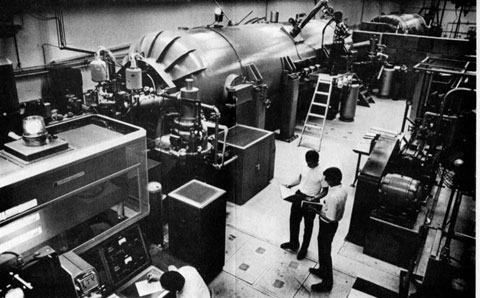 What prompted this rant is that someone built their own 12" Cyclotron with a definitely non-shabby 1MEv beam power out of pocket change and good hacking skills...
From Physics Today:
bq. Building a Cyclotron on a Shoestring
Starting when he was an undergrad, Tim Koeth built a 12−inch cyclotron. Now he is in grad school and his creation is used in a senior−level lab class.
bq. I was immediately obsessed," says Timothy Koeth, who, as a sophomore in physics in 1995 at Rutgers University, got the bug to build a cyclotron. "I was sitting in Tom Devlin's modern physics lecture," recalls Koeth. "He described the principle of the cyclotron. He said it required a lot of RF power. I was�and am�a ham radio operator, so RF was no problem. It needed a big magnet; I knew I could find one of those. How tough could a vacuum system and chamber be?" Some six years later, Koeth's 12−inch machine became part of an undergraduate lab course.
Heh... This is hacking -- old school...
What prompted this rant is that someone built their own 12" Cyclotron with a definitely non-shabby 1MEv beam power out of pocket change and good hacking skills...
From Physics Today:
bq. Building a Cyclotron on a Shoestring
Starting when he was an undergrad, Tim Koeth built a 12−inch cyclotron. Now he is in grad school and his creation is used in a senior−level lab class.
bq. I was immediately obsessed," says Timothy Koeth, who, as a sophomore in physics in 1995 at Rutgers University, got the bug to build a cyclotron. "I was sitting in Tom Devlin's modern physics lecture," recalls Koeth. "He described the principle of the cyclotron. He said it required a lot of RF power. I was�and am�a ham radio operator, so RF was no problem. It needed a big magnet; I knew I could find one of those. How tough could a vacuum system and chamber be?" Some six years later, Koeth's 12−inch machine became part of an undergraduate lab course.
Heh... This is hacking -- old school...
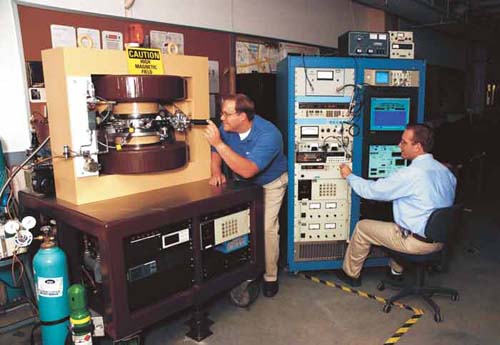
What prompted this rant is that someone built their own 12" Cyclotron with a definitely non-shabby 1MEv beam power out of pocket change and good hacking skills...
From Physics Today:
bq. Building a Cyclotron on a Shoestring
Starting when he was an undergrad, Tim Koeth built a 12−inch cyclotron. Now he is in grad school and his creation is used in a senior−level lab class.
bq. I was immediately obsessed," says Timothy Koeth, who, as a sophomore in physics in 1995 at Rutgers University, got the bug to build a cyclotron. "I was sitting in Tom Devlin's modern physics lecture," recalls Koeth. "He described the principle of the cyclotron. He said it required a lot of RF power. I was�and am�a ham radio operator, so RF was no problem. It needed a big magnet; I knew I could find one of those. How tough could a vacuum system and chamber be?" Some six years later, Koeth's 12−inch machine became part of an undergraduate lab course.
Heh... This is hacking -- old school...


Hi Reece
Couple of things...
#1. - Using atmosphere as a fuel source:
A cyclotron is a very highly tuned system which balances the mass of the ions being injected with the overall magnetic field and the acceleration potential and frequency. What is right for one atomic mass will fail to accelerate something lighter and will leave skid marks on the outside walls for anything heavier.
#2. - Using atmosphere as a fuel source:
This makes me think that you want to use the cyclotron in the atmosphere as part of the lift from Earth to Orbit. If you look at the literature for ion drives (these are widely used), the available thrust is measured in ounces at most. They are awesome for doing minor orbital corrections for geosync satellites but for heavy lifting, forget it. For the sake of discussion, if you _were_ able to develop enough thrust to lift a spacecraft, your beam would render the ground underneath highly radioactive and sterile for several tens of miles. Greenpeace would not be amused...
#3. - Why a cyclotron:
The commercial ion engines work just fine without hauling a 2.5 ton magnet into space __plus__ the power source to run the magnet and the RF oscillators. An Ion Engine just uses a nice dense gas (Xenon is used a lot) and an acceleration potential of about 15KV. This works fine so the additional complexity (and mass) of the cyclotron is of no benefit. Literally. Cyclotrons are cool but they are not a cure for this question.
Here are three links:
Boeing for their Xenon Ion Engines
http://www.boeing.com/defense-space/space/bss/factsheets/xips/xips.html
The Space Daily article on the European SMART-1 Spacecraft which uses an Ion Engine
http://www.spacedaily.com/news/lunar-04i.html
And finally, the Google search which turned up these two links as well as over 20,000 others for your research fun!
http://www.google.com/search?hl=en&q=ion+engine+satellite+orbit+correction
Take care and welcome to my little corner of the net...
HI!
My name is Reece Love and I am a Aeronautical Engineering student at Embry-Riddle Aeronautics University in Prescott Arizona. I am interested in building a cyclotron for space propulsion purposes. It would need to be small, as I would like to build a working model of the engine. The cyclotron would use any atmosphere as a fuel source to power the cyclotron. What do you suggest?