From National Public Radio no less:
The School Shootings That Weren't
How many times per year does a gun go off in an American school?
We should know. But we don't.
This spring the U.S. Education Department reported that in the 2015-2016 school year, "nearly 240 schools ... reported at least 1 incident involving a school-related shooting." The number is far higher than most other estimates.
But NPR reached out to every one of those schools repeatedly over the course of three months and found that more than two-thirds of these reported incidents never happened. Child Trends, a nonpartisan nonprofit research organization, assisted NPR in analyzing data from the government's Civil Rights Data Collection.
We were able to confirm just 11 reported incidents, either directly with schools or through media reports.
In 161 cases, schools or districts attested that no incident took place or couldn't confirm one. In at least four cases, we found, something did happen, but it didn't meet the government's parameters for a shooting. About a quarter of schools didn't respond to our inquiries.
"When we're talking about such an important and rare event, [this] amount of data error could be very meaningful," says Deborah Temkin, a researcher and program director at Child Trends.
A lot more at the site - NPR goes into great detail. These numbers are generated by unelected administrators with no training in statistics and we rely on them to form public policy. The joys of working with a bureaucracy - Jerry Pournelle's Iron Law is worth remembering here:
Pournelle's Iron Law of Bureaucracy states that in any bureaucratic organization there will be two kinds of people":
First, there will be those who are devoted to the goals of the organization. Examples are dedicated classroom teachers in an educational bureaucracy, many of the engineers and launch technicians and scientists at NASA, even some agricultural scientists and advisors in the former Soviet Union collective farming administration.
Secondly, there will be those dedicated to the organization itself. Examples are many of the administrators in the education system, many professors of education, many teachers union officials, much of the NASA headquarters staff, etc.
The Iron Law states that in every case the second group will gain and keep control of the organization. It will write the rules, and control promotions within the organization.
Truer words were never written... I will close with this great graphic based on numbers from the Department of Education:
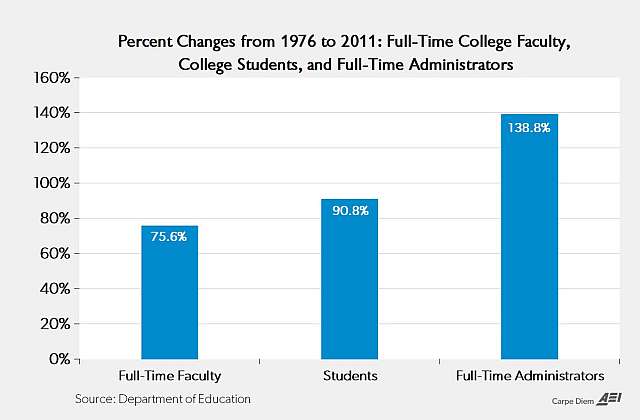
Swiped from PBS - this link


Leave a comment